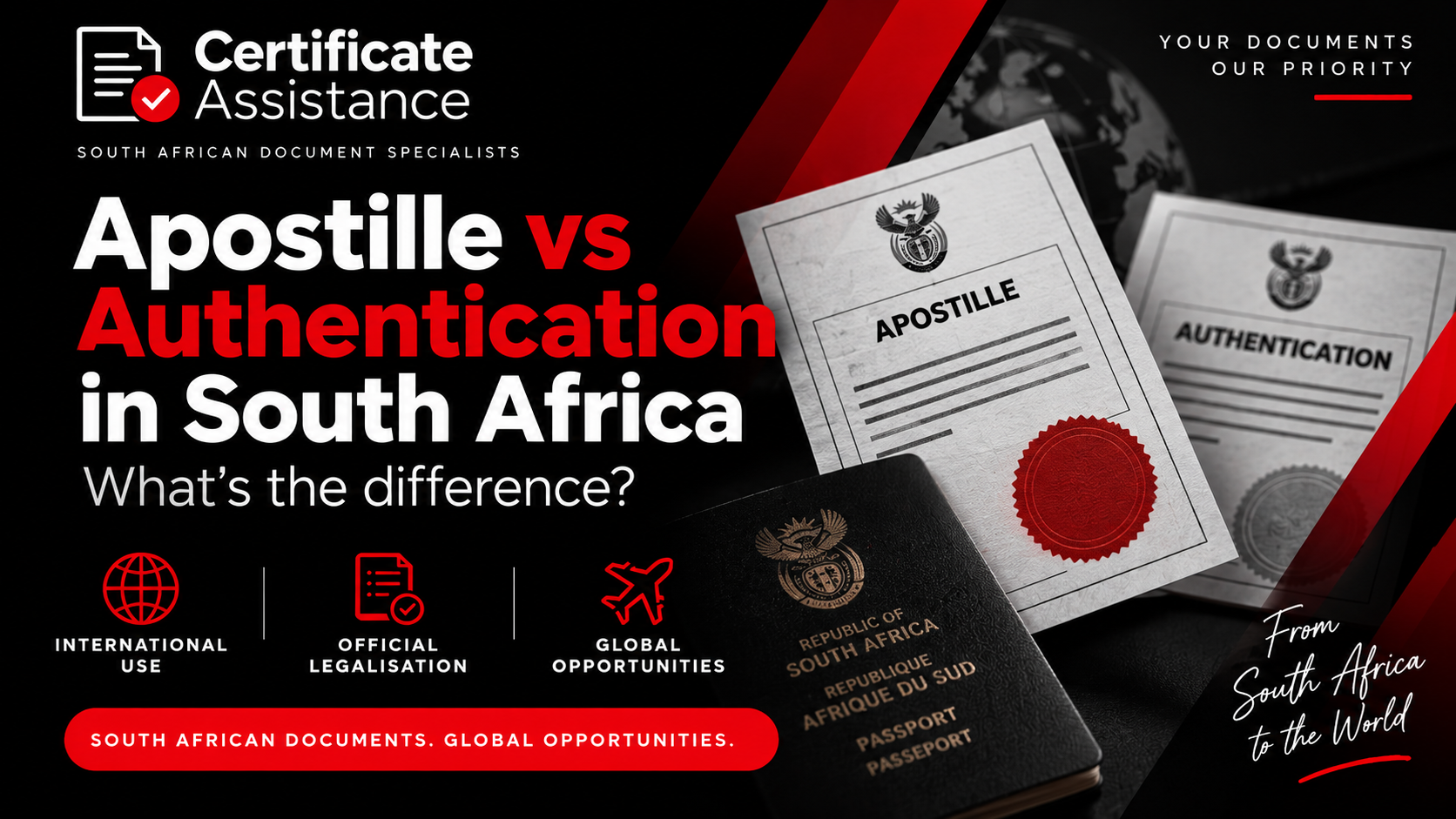
Apostille vs Authentication in South Africa: What’s the Difference?
If you need to use a South African document in another country, you may be told that it needs an Apostille, authentication or legalisation.
These terms are often confused, but they do not always mean the same thing.
The correct process mainly depends on the country where your document will be used and the type of South African document you have.
Understanding the difference before submitting your documents can save time, prevent unnecessary processing and help you avoid having a document rejected overseas.
What Is Document Legalisation?
Legalisation is the process used to prepare an official South African document for use in another country.
According to the Department of International Relations and Cooperation (DIRCO), legalisation verifies the signature and seal on an official public document.
The legalisation process does not confirm that every statement contained in the document is true.
Instead, it confirms the origin of the document and the authority of the person or institution that signed or issued it.
What Is an Apostille?
An Apostille Certificate is a form of legalisation used when the country where the document will be used participates in the Hague Apostille Convention.
The Apostille Convention simplifies the process of using public documents between participating countries.
Instead of requiring several stages of embassy or consular legalisation, an Apostille Certificate confirms the origin, signature and seal of the document.
Examples of documents that may require an apostille include:
• Birth certificates
• Marriage certificates
• Death certificates
• Police Clearance Certificates
• Letters of No Impediment
• Certain notarised documents
• Court or legal documents
• Educational or other official documents, depending on the circumstances
The exact process depends on the document type.
What Is Authentication?
Authentication is used where the destination country does not use the Hague Apostille process for the document concerned.
DIRCO refers to this as a Certificate of Authentication.
Authentication also verifies the official signature and seal on the document, but the process may involve additional stages before the document is accepted in the destination country.
Depending on the country, further embassy or consular legalisation may also be required.
Apostille vs Authentication: The Main Difference
The main difference is the destination country.
If the document will be used in a country where the Hague Apostille Convention applies between South Africa and that country, an apostille will generally be the appropriate form of legalisation.
If the destination country is not covered by the Apostille Convention, authentication and potentially further legalisation may be required.
You should always confirm the current requirements with the authority receiving your document.
How Do I Know Which One I Need?
Before arranging any legalisation, establish:
• Which country the document will be used in
• What type of document you have
• Whether the receiving authority requires an original document
• Whether the document must first be notarised
• Whether an Apostille Certificate or Certificate of Authentication is required
• Whether additional embassy legalisation is necessary
Do not arrange an apostille simply because your document is going overseas.
The destination country and the type of document determine the correct process.
Which Documents Can Go Directly to DIRCO?
Certain original South African public documents can generally be submitted directly to DIRCO for legalisation when they contain the required official signatures and stamps.
These may include eligible original:
• Birth certificates
• Marriage certificates
• Death certificates
• Letters of No Impediment
• Police Clearance Certificates
The document must meet DIRCO's requirements before it can be legalised.
For example, a document without the appropriate authorised signature or stamp may first need to be corrected or reissued.
What About Notarised or Private Documents?
Some documents follow a different route.
Private documents, certified copies, agreements, powers of attorney and certain other documents may first need to be notarised by a South African Notary Public.
The notary's signature may then need to be verified by the relevant High Court.
Where the destination country is covered by the Apostille Convention, the relevant High Court may issue the apostille for certain notarised documents.
Where authentication is required instead, additional legalisation steps may apply.
This is why it is important to identify the document type before deciding whether DIRCO or a High Court process is required.
DIRCO Apostille vs High Court Apostille
Both can produce an Apostille Certificate, but they are used for different categories of documents.
Certain original South African public documents are legalised directly through DIRCO.
Certain notarised or private documents may instead require the Notary Public and High Court route.
You should not automatically send every document to DIRCO or every document to the High Court.
The correct route depends on the document.
How Long Does Apostille or Authentication Take?
Certificate Assistance currently estimates:
DIRCO Apostille / Authentication:
Approximately 7–14 working days
High Court Apostille:
Approximately 2–3 working days
Processing periods are estimates and may vary depending on document requirements, the issuing authority and the legalisation route required.
How Much Does Certificate Assistance Charge?
Certificate Assistance currently charges:
DIRCO Apostille / Authentication:
R700 per document
High Court Apostille:
R700 per document
Notarisation:
R550 per page
These are Certificate Assistance service charges for professional assistance, handling and processing support.
DIRCO's own Legalisation Services are offered by the government free of charge.
Additional charges may apply for courier delivery, notarisation or other services where required.
Does an Apostille Prove That a Document Is Genuine?
An apostille verifies the origin of a public document, including the relevant signature, seal or official capacity.
It does not independently verify every statement or fact contained in the document.
This distinction is important.
The apostille allows the receiving authority to recognise the document's official origin without requiring the traditional longer legalisation process between countries participating in the Apostille Convention.
Do All Countries Accept Apostilles?
No.
An Apostille Certificate is used within the framework of the Hague Apostille Convention.
The Hague Conference on Private International Law maintains the current list of participating countries.
Even where the Convention applies, you should still confirm what the organisation receiving your document requires.
A foreign authority may have requirements regarding:
• The age of the document
• Whether an original is required
• Translation
• Supporting documentation
• The specific version of a certificate
Can a Certified Copy Be Apostilled?
It depends on the document and the process being used.
A certified copy is not automatically equivalent to legalising the original public document.
Some copies may first require notarisation and High Court processing.
If an overseas authority specifically requests an apostilled original document, providing an apostilled copy may not satisfy their requirement.
Always confirm exactly what form of the document they need.
Can I Arrange Apostille or Authentication from Overseas?
Yes.
Many South Africans living abroad need documents from South Africa legalised for immigration, citizenship, marriage, employment, study or other international processes.
Certificate Assistance can assist clients locally and internationally with:
• Document preparation
• DIRCO Apostille and Authentication
• High Court Apostille
• Notarial assistance
• South African certificates and Police Clearances
• Secure international courier delivery
You can provide the relevant information from overseas and we can guide you on the correct South African process.
Common Mistakes to Avoid
One of the most common mistakes is arranging an apostille before confirming that an apostille is actually required.
Other common problems include:
• Using the wrong version of a certificate
• Submitting an abridged document when an unabridged original is required
• Sending the document to the wrong legalisation authority
• Apostilling a copy when the authority needs the original
• Not checking the destination country's requirements
• Discovering too late that notarisation is required
• Using an outdated document when the receiving authority requires a recent one
Confirming the requirements first can save considerable time.
What Should You Ask the Receiving Authority?
Before starting the process, ask the embassy, immigration authority, employer, university, court or other organisation receiving your document to confirm:
• Exactly which document is required
• Whether it must be an original
• Whether an apostille is required
• Whether authentication is required
• Whether embassy legalisation is required
• Whether a certified translation is needed
• How recently the document must have been issued
If you receive written instructions and are unsure what they mean, send them to Certificate Assistance and we can help you understand which South African process may be required.
Need Apostille or Authentication Assistance?
Certificate Assistance assists clients in South Africa and worldwide with Apostille, Authentication and legalisation of South African documents.
If you are unsure whether your document requires DIRCO, a High Court Apostille, notarisation or another authentication process, tell us:
• What document you have
• Which country it will be used in
• What the receiving authority has requested
We can then guide you on the appropriate process before you submit your documents.