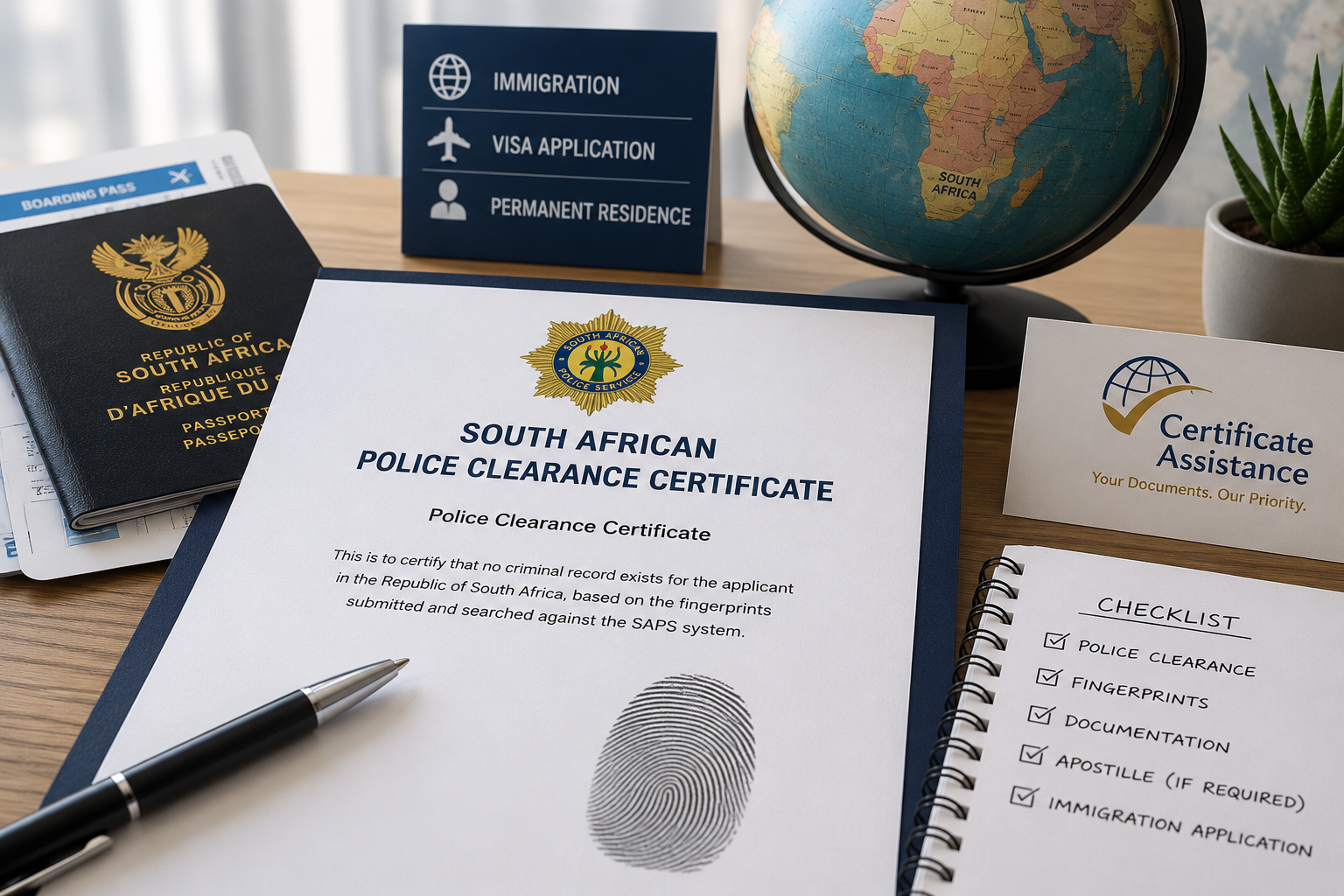
Educational guide: This article explains how a South African Police Clearance Certificate can fit into a visa or immigration application. Certificate Assistance is a private independent business and is not SAPS, DIRCO or any immigration authority.
A South African Police Clearance Certificate may be requested for a visa, immigration, permanent residence, citizenship, overseas employment or another international process. The authority receiving your application decides whether you need one, how recent it must be and whether it needs legalisation.
What Is a South African Police Clearance Certificate?
The South African Police Service (SAPS) describes a Police Clearance Certificate, or PCC, as an official document issued through Criminal Record and Crime Scene Management stating whether or not criminal convictions have been recorded against an individual.
SAPS specifically makes the service available to people who need confirmation of their criminal status for emigration, travel or employment abroad.
Do I Need a Police Clearance Certificate for a Visa?
Not every visa has the same rule. Requirements depend on the destination country, visa category, applicant's age and residence history.
Some immigration authorities ask for police certificates from countries where an applicant lived for a certain period. Others use different thresholds. Always follow the official checklist for your exact visa category.
If the visa authority asks for a South African Police Clearance Certificate, make sure it specifically means the SAPS-issued PCC rather than another type of criminal-record document.
What Documents Are Required for a South African Police Clearance Certificate?
According to SAPS, a Police Clearance application generally requires:
- A full set of fingerprints.
- A completed application form.
- A certified copy of the applicant's identity document or passport.
- Documentary proof if a maiden surname or other surname must appear on the certificate.
- Proof of payment of the prescribed SAPS fee.
For the detailed checklist, see our documents required for a SAPS Police Clearance Certificate guide.
How Much Is the SAPS Police Clearance Fee?
SAPS currently lists the prescribed government fee as R190 per Police Clearance application.
This is the SAPS government application fee. It should not be confused with courier, fingerprinting, private assistance or document-handling charges that may arise separately.
Fingerprint Requirements for a Visa Police Clearance
If you live in South Africa, SAPS states that fingerprints must be taken by the South African Police Service on the SAPS 91(a) form.
If you live outside South Africa, fingerprints may be taken at a police station in the country where you live or at a South African Embassy. SAPS allows the official fingerprint form of that country or, where available, the SAPS 91(a) form.
SAPS states that copies or scanned versions of fingerprints will not be processed.
See our Police Clearance fingerprint requirements guide.
Can I Apply for a South African Police Clearance While Living Overseas?
Yes. SAPS allows applicants living abroad to send their application and required documents directly to Criminal Record and Crime Scene Management in South Africa.
You do not automatically need to return to South Africa simply because you need a South African PCC.
However, original physical documents and acceptable fingerprints remain important, so allow for international courier time where necessary.
See our South African Police Clearance while living abroad guide.
Where Is the Police Clearance Processed?
SAPS states that issuing a Police Clearance Certificate is the responsibility of Criminal Record and Crime Scene Management in Pretoria.
Applicants in South Africa may ask a police station to forward the application to Pretoria, deliver it in person, or use postal or courier services. Applicants abroad may send the required documents directly to the Pretoria office.
How Long Does a South African Police Clearance Certificate Take?
SAPS currently states that finalisation takes approximately 15 working days from the date when all required documents are received by Criminal Record and Crime Scene Management in Pretoria. Postal or courier time is excluded.
However, SAPS currently also displays a backlog notice warning that waiting periods have been extended. The published 15-working-day period should therefore be treated as a standard estimate rather than a guaranteed completion date.
See our Police Clearance processing-time guide.
How Can I Track My SAPS Police Clearance Certificate?
SAPS provides an online enquiry facility where applicants can check available status information using their reference details and identity information.
If a South African cellphone number is provided on the application, SAPS states that an SMS can be sent when the application is received and another when it is completed.
See our guide to tracking a SAPS Police Clearance Certificate.
Will SAPS Email the Completed Police Clearance Certificate?
No. SAPS states that completed Police Clearance Certificates are not scanned and emailed to applicants.
For security purposes, the physical completed certificate is handed to the applicant, the nominated person or the chosen courier according to the application instructions.
Read our guide to whether SAPS emails Police Clearance Certificates.
What Happens if the Certificate Is Not Collected?
SAPS states that completed Police Clearance Certificates not collected within three months after finalisation will be destroyed.
This is particularly important for overseas applicants arranging collection by a representative or courier.
What if I Need My Maiden Name or Previous Surname on the PCC?
SAPS states that a maiden surname or other surname must be mentioned in the application if it needs to appear on the certificate, and documentary proof must be attached.
A certified marriage certificate is one example SAPS gives as supporting proof.
See our maiden-name Police Clearance guide.
How Recent Must a Police Clearance Be for a Visa?
There is no universal visa rule that applies to every country. The immigration or visa authority decides how recent the Police Clearance Certificate must be when you submit your application.
If the PCC also needs DIRCO legalisation, DIRCO states that the original SAPS Police Clearance Certificate must be no older than six months from its date of issue.
See our South African Police Clearance validity guide.
Does a South African Police Clearance Certificate Need an Apostille?
Not automatically. Whether the PCC needs legalisation depends on the destination country and the authority receiving it.
If legalisation is required, the correct route may be an Apostille or a Certificate of Authentication.
DIRCO states that an original SAPS Police Clearance Certificate submitted for legalisation must be no older than six months.
Read our guide to Apostilling a South African Police Clearance Certificate and our DIRCO Apostille process guide.
Police Clearance for Visa vs Police Clearance for Immigration
In practice, people use terms such as visa PCC, immigration police clearance and overseas police certificate interchangeably. The underlying South African document is still the SAPS Police Clearance Certificate.
What changes is the receiving authority's requirement: the document age, whether legalisation is required, whether translations are required and which countries must provide police certificates.
South African Police Clearance for the UK, Australia, Canada and New Zealand
Country-specific requirements differ, so use the official immigration authority for the visa rule itself. We also maintain educational country guides explaining the South African document side of the process:
Common Visa PCC Mistakes to Avoid
- Applying before checking how recent the visa authority requires the PCC to be.
- Submitting scanned fingerprints instead of acceptable originals.
- Leaving out a maiden or previous surname that the visa documents use.
- Assuming the 15-working-day SAPS estimate is guaranteed during a backlog.
- Assuming every visa PCC automatically needs an Apostille.
- Waiting too long to arrange collection after the certificate is finalised.
- Forgetting to allow courier and legalisation time in addition to SAPS processing.
Visa Police Clearance Checklist
- Read the official visa authority's police-certificate requirement.
- Confirm whether South Africa is one of the countries from which you need a police certificate.
- Check the required age or validity of the PCC.
- Arrange acceptable fingerprints.
- Prepare the application, identity documents and payment proof.
- Declare maiden or previous surnames where needed.
- Submit the application to the correct SAPS process.
- Track the application using the SAPS enquiry facility.
- Arrange collection or courier delivery once finalised.
- Complete Apostille, Authentication or translation only if the receiving authority requires it.
Official SAPS Information
For current application requirements, fees, addresses and processing notices, use the official SAPS Police Clearance Certificate page.
Visa rules can change independently of SAPS requirements, so also check the official immigration, embassy or consular authority responsible for your specific visa.
Quick Summary
A South African Police Clearance Certificate may be required for a visa or immigration application, but the visa authority determines whether you need one. SAPS currently requires original fingerprints, an application, identity documentation and payment proof, and publishes an approximate 15-working-day processing period after complete documents reach Pretoria while also warning of a current backlog.