If a South African Police Clearance Certificate will be used overseas, the receiving authority may require a DIRCO Apostille or Authentication. DIRCO currently requires the original SAPS Police Clearance Certificate to be no older than six months for legalisation.
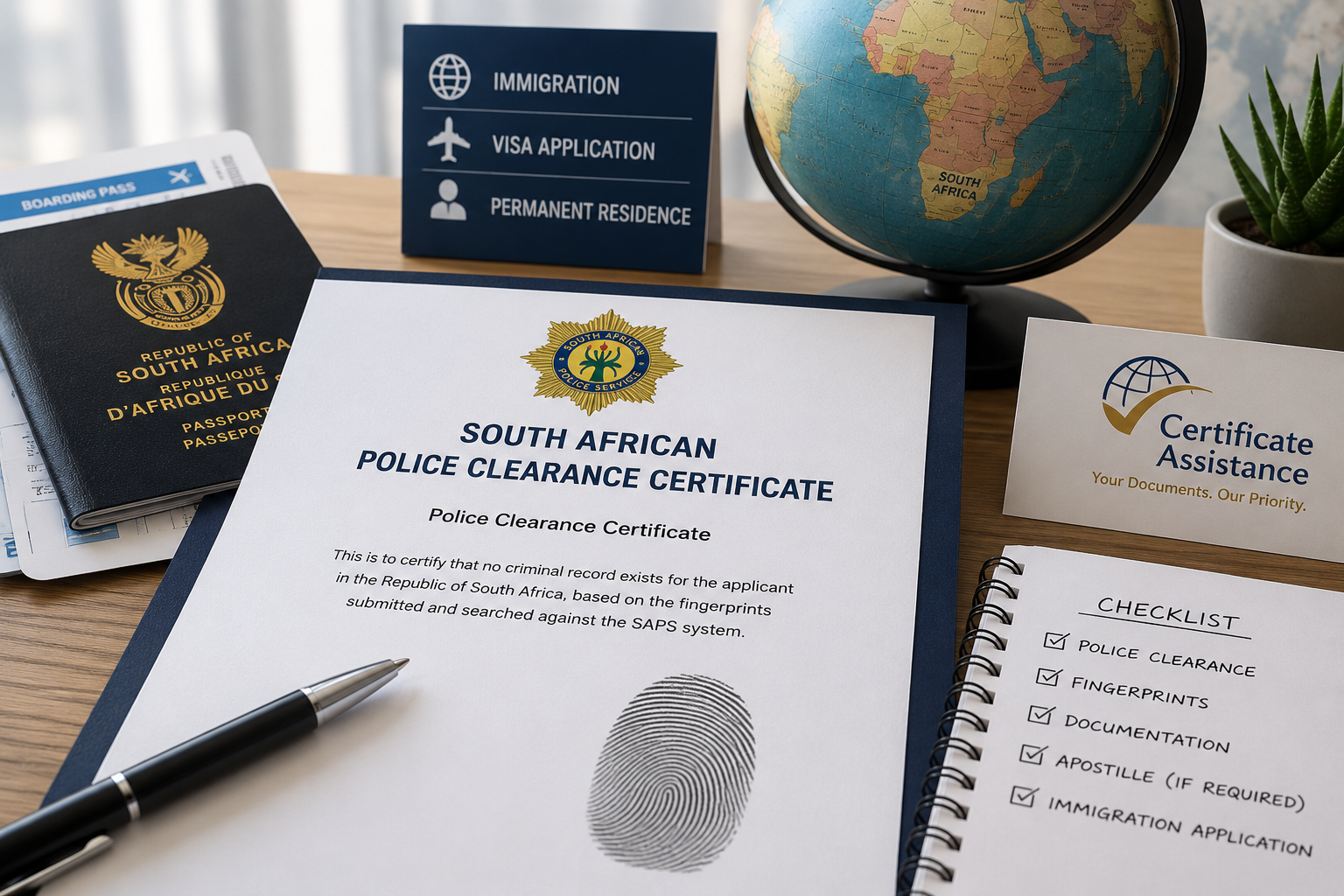
To Apostille a South African Police Clearance Certificate, first obtain the original SAPS certificate. DIRCO currently requires the original PCC to be no older than six months for legalisation. Whether you need an Apostille or Authentication depends on the destination country.
A South African Police Clearance Certificate (PCC) is commonly requested when applying for immigration, permanent residence, citizenship, employment, visas or other official processes abroad.
If your South African Police Clearance Certificate will be submitted in another country, obtaining the certificate may only be the first step. Depending on the destination country and the authority requesting the document, the Police Clearance Certificate may also need to be authenticated or Apostilled before it can be accepted.
This guide explains the process and the main steps to consider.
A South African Police Clearance Certificate is an official document issued by the South African Police Service (SAPS).
It records whether criminal convictions have been recorded against an individual based on the information and fingerprints submitted for the application.
Police Clearance Certificates are frequently required for:
• Immigration applications
• Permanent residence applications
• Citizenship applications
• Overseas employment
• Work permits
• Visa applications
• Foreign residency applications
• Other official international processes
The requirements depend on the country and immigration programme you are applying through.
Many immigration authorities request police clearance certificates from countries where an applicant has previously lived for a specified period.
If you previously lived in South Africa, you may therefore be asked to obtain a South African Police Clearance Certificate even if you currently live overseas.
Always check the requirements of the immigration authority handling your application because document requirements can differ between countries and visa categories.
A Police Clearance Certificate application generally requires fingerprints and the applicant's personal information.
The fingerprints and supporting documentation are submitted for processing through the relevant South African Police Service procedures.
Applicants living outside South Africa may still be able to obtain the required fingerprints in their current country and arrange for the application documentation to be sent to South Africa.
Processing times can vary, so applicants should avoid leaving the Police Clearance Certificate until the final stages of an immigration application.
DIRCO’s current Legalisation guidance says that an original SAPS Police Clearance Certificate can be submitted directly for Apostille or Authentication, but it must be no older than six months from the date of issue. Certified copies are not accepted for this direct legalisation route, and laminated documents are not accepted.
Not every Police Clearance Certificate requires an Apostille.
Whether an Apostille is required depends primarily on the country where the certificate will be used and the requirements of the organisation receiving it.
When an Apostille is required, the Police Clearance Certificate normally needs to complete the appropriate South African authentication process before being presented abroad.
For qualifying South African documents, Apostilles are handled through the Department of International Relations and Cooperation (DIRCO).
The receiving authority should always be consulted before beginning the authentication process.
An Apostille is a form of authentication used between countries participating in the Hague Apostille Convention.
It verifies the origin of a public document so that the document can be presented to authorities in another participating country.
DIRCO provides Apostille and authentication services for qualifying South African public documents.
The Apostille does not change the information contained in your Police Clearance Certificate. It authenticates the relevant signature, seal or official capacity associated with the document.
For an immigration application requiring both documents, the process generally follows this order:
1. Determine the immigration authority's Police Clearance requirements.
2. Obtain the required fingerprints and supporting documents.
3. Apply for the South African Police Clearance Certificate.
4. Receive the completed Police Clearance Certificate.
5. Confirm whether the destination country requires an Apostille or another form of authentication.
6. Submit the qualifying document through the appropriate authentication process.
7. Present the completed documents to the relevant immigration authority.
Requirements can differ depending on the destination country, so the exact process should always be confirmed before submission.
SAPS states that applicants living outside South Africa may have fingerprints taken at a police station in their current country or at a South African Embassy. The fingerprints may be taken on that country’s official fingerprint form or, where available, on the SAPS 91(a) form.
South Africans living abroad frequently need Police Clearance Certificates for immigration, residency or employment applications.
Being outside South Africa does not necessarily mean you need to return to South Africa to complete the entire process.
Depending on your circumstances, fingerprints may be taken by an authorised organisation in your current country and the required documents can then be sent to South Africa for processing.
International courier time should be included when planning your application.
Police Clearance and Apostille processing times can change according to government processing volumes, document requirements and individual circumstances.
If you require both a Police Clearance Certificate and an Apostille, remember that these are separate stages.
You should therefore allow sufficient time for:
• Fingerprint preparation
• Police Clearance processing
• Courier delivery where applicable
• Apostille or authentication processing
• Return delivery
Starting early can reduce the risk of document processing delaying an immigration or visa application.
An immigration requirement and a DIRCO legalisation requirement are not always identical. Compare the South African Police Clearance visa checklist with the certificate-validity rules before deciding when to apply.
Certificate Assistance assists clients in South Africa and abroad with South African document processes, including Police Clearance Certificates and qualifying DIRCO Apostille submissions and collections.
If you are unsure which process applies to your documents, contact us before submitting your application so that the requirements can be checked.
Yes. Applicants living outside South Africa can apply for a South African Police Clearance Certificate, although fingerprints and supporting documentation will still be required.
No. Apostille requirements depend on where the document will be used and what the receiving authority requires. Confirm the requirement with the organisation requesting your certificate.
No. If the Police Clearance Certificate itself needs to be Apostilled, the certificate must first be issued before the relevant authentication process can be completed.
If you need a South African Police Clearance Certificate for immigration or need assistance with the Apostille process, Certificate Assistance can help coordinate the relevant South African document process.
Start your application or contact Certificate Assistance to discuss your requirements.
Official guidance: For current authority-issued requirements, refer to the official SAPS Police Clearance application instructions. If the receiving authority requires legalisation, also check DIRCO's original-document and Apostille rules. Verify the latest instructions and the receiving organisation's requirements before submitting documents.
DIRCO states that an original SAPS Police Clearance Certificate must be no older than six months from the date of issue for legalisation.
DIRCO’s direct legalisation guidance requires the original SAPS Police Clearance Certificate. Certified copies are not accepted for direct legalisation of the underlying Police Clearance Certificate.
Yes. The Police Clearance Certificate must first be issued, after which the original qualifying certificate can be submitted to DIRCO for Apostille or Authentication depending on the destination country.
Our guides are prepared to help South Africans understand document requirements, processing, Apostille and Authentication steps, and overseas use. Where possible, we check current requirements against official authorities and clearly distinguish our private service estimates from government processing.
Learn more about Certificate Assistance and our editorial approachCertificate Assistance helps individuals and businesses obtain essential South African certificates and documents with a simpler, more convenient process. We provide professional assistance with Police Clearance Certificates and other certificate-related services, helping clients navigate applications efficiently and with confidence.
START YOUR REQUEST
Tell us what South African document you need, where it will be used and your timing. We’ll review the details and guide you on the correct next step.
Send us the basics and we’ll help you identify the correct document route, expected process and next steps.
✓ Private South African document assistance
✓ Support for clients in South Africa and abroad
✓ Courier and Apostille guidance where required
WhatsApp: +27 76 391 5008info@certificateassistance.comTell us what South African document you need, where it will be used and your timing. We’ll review the details and explain the next step.